Cervical Dystonia: Botulinum Toxin Treatment
Cervical dystonia causes involuntary turning, tilting, flexion or extension of the head and neck. It is often associated with pain and may also include head tremor. Botulinum toxin treatment can selectively reduce the activity of muscles contributing to the abnormal movement pattern.
What is cervical dystonia?
Cervical dystonia is a focal dystonia in which involuntary muscle activity causes abnormal postures or repetitive movements of the head and neck.
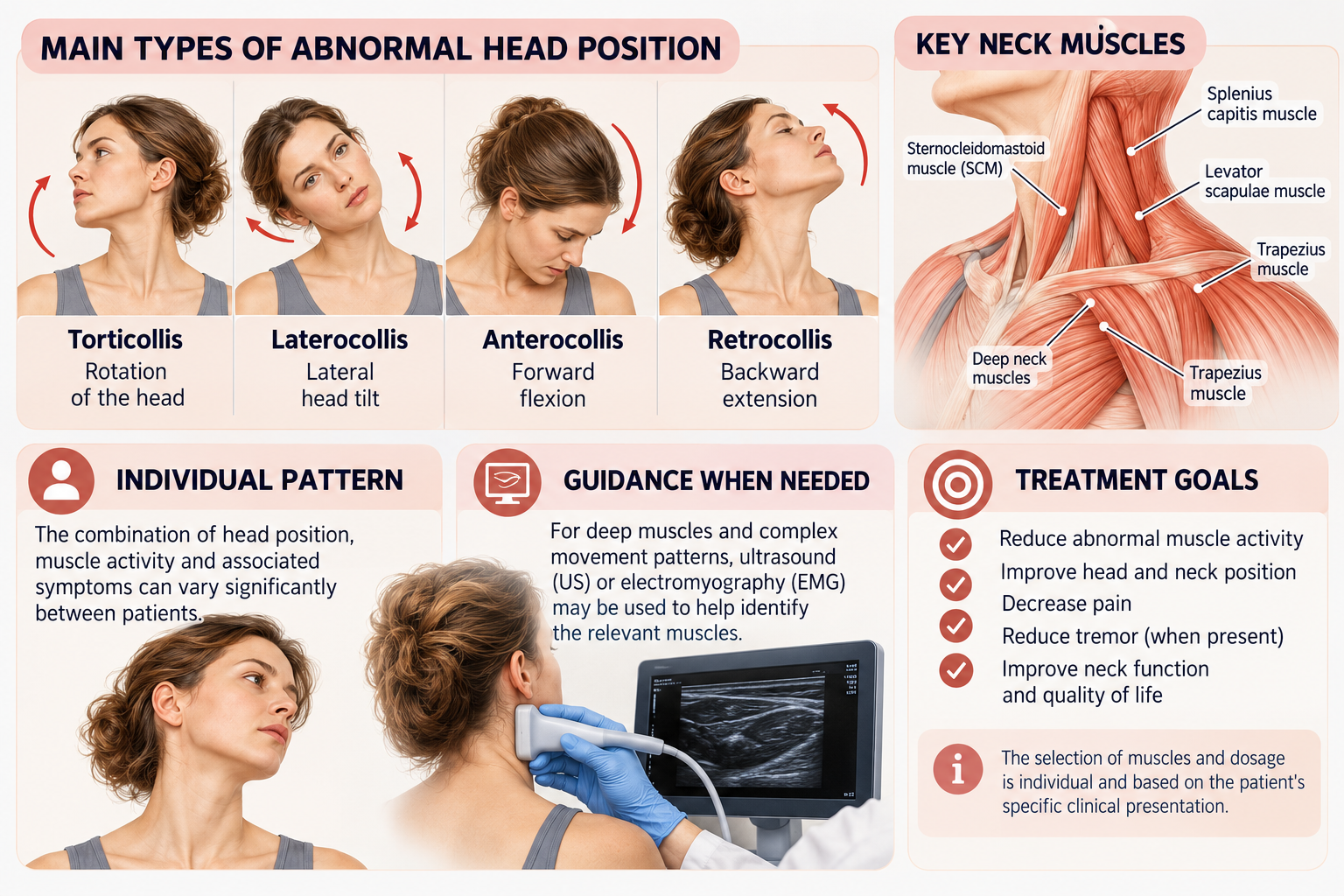
Some patients mainly have head rotation, while others have lateral tilt, forward flexion or backward extension. Mixed patterns are common, and similar-looking head positions may be produced by different combinations of active muscles.
Common symptoms
- involuntary turning or tilting of the head;
- difficulty keeping the head in a neutral position;
- neck and shoulder pain;
- elevation of one shoulder;
- head tremor or jerky movements;
- restricted neck movement;
- worsening with stress or specific activities.
Main patterns of cervical dystonia
These classical terms describe the direction of abnormal head and neck posture. In clinical practice, pure forms are less common than mixed patterns containing several components.
Torticollis
Predominant rotation of the head to one side.
Laterocollis
Lateral tilt of the head and neck toward the shoulder.
Anterocollis
Predominant forward flexion of the head or neck.
Retrocollis
Predominant backward extension of the head or neck.
Botulinum toxin treatment for cervical dystonia
Botulinum toxin is one of the main treatments for focal cervical dystonia. It is injected directly into muscles contributing to the abnormal posture or movement.
The treatment temporarily reduces acetylcholine release at the neuromuscular junction, decreasing excessive activity in selected muscles.
The goal is not to make the neck as weak as possible, but to restore a better balance between muscle groups, reduce abnormal movements and pain, and improve the ability to hold and move the head more comfortably.
Why the same injection pattern cannot be used for everyone
Head position is produced by the combined action of multiple muscles. Two patients with a similar visible rotation may have very different underlying patterns of muscle activity.
Splenius capitis
May contribute to rotation, extension and some patterns of dystonic head tremor.
Sternocleidomastoid
Commonly contributes to rotational and mixed patterns, but should be evaluated together with other muscles.
Levator scapulae
May contribute to lateral tilt, rotation and abnormal positioning of the shoulder girdle.
Trapezius
Can form part of complex patterns involving both neck and shoulder position.
Deep neck muscles
Deep muscles can be important in specific movement patterns and may require more precise localisation.
Muscle combinations
In most patients, the abnormal posture is produced by several muscles rather than one isolated muscle.
Head or neck: why the distinction matters
A detailed assessment considers not only the direction of movement, but also the anatomical level at which the movement is generated. Modern analysis distinguishes predominantly upper cervical head movement from movement of the cervical spine relative to the trunk.
Predominantly head movement
The abnormal movement occurs mainly in the upper cervical segments, with the head changing position relative to the neck.
A rotational pattern at this level may be described as torticaput.
Predominantly neck movement
The cervical spine changes position relative to the trunk. Different muscle groups may be involved compared with a visually similar head movement.
A rotational pattern at this level corresponds to classical torticollis.
How treatment is performed
Movement analysis
Head and neck position, direction of movement, tremor, pain, shoulder position and compensatory movements are assessed.
Muscle selection
The muscles contributing most strongly to the abnormal movement are identified.
Injections
Botulinum toxin is distributed between selected muscles using individually determined doses.
Response assessment
The outcome of the previous cycle is used to refine the next treatment session.
When ultrasound or EMG guidance may be useful
Many superficial muscles can be identified accurately from anatomical landmarks and clinical examination. In other situations, additional guidance can help localise the target muscle more precisely.
Ultrasound allows direct visualisation of muscles and nearby structures, while EMG can help identify muscles showing abnormal activity.
Guidance may be especially useful for
- deep neck muscles;
- complex mixed patterns;
- prominent dystonic head tremor;
- uncertain anatomical localisation;
- suboptimal response to previous treatment.
Head tremor in cervical dystonia
In some patients, cervical dystonia includes not only an abnormal sustained posture but also dystonic head tremor.
The tremor may be irregular, become more noticeable in specific head positions and coexist with rotation or lateral tilt.
When tremor is prominent, it is particularly important to identify the muscles contributing to the oscillatory movement. The injection pattern may therefore differ from treatment of predominantly tonic dystonia.
Pain in cervical dystonia
Neck and shoulder pain is one of the most common and clinically important symptoms of cervical dystonia. For some patients, pain is the main reason for seeking neurological treatment.
Botulinum toxin treatment can reduce not only abnormal posture and movement but also dystonia-related pain. Pain relief should therefore be assessed separately when evaluating the response to treatment.
When does the effect begin?
If previous injections did not help enough
An insufficient response to previous botulinum toxin treatment does not always mean that the treatment itself is ineffective. Before abandoning the approach, it is useful to understand why the response was limited.
Reassess the movement pattern
Dystonia can change over time, and the original injection strategy may not have addressed all components of the movement.
Reconsider target muscles
Visible posture alone does not always reveal the true muscles driving the dystonia.
Review dose distribution
The total dose matters, but so does the way it is distributed between individual muscles.
Review duration of benefit
It is useful to know whether there was any benefit, when it began, how strong it was and how long it lasted.
In selected cases, diagnosis, injection technique, the need for guidance and uncommon causes of secondary treatment failure may also need review.
Safety and possible side effects
Botulinum toxin treatment for cervical dystonia is generally well tolerated. Local discomfort, a small bruise or temporary weakness of some neck muscles may occur.
Most adverse effects are temporary and gradually resolve as the effect of the medication decreases.
Important possible effects include
- local pain or tenderness;
- temporary neck weakness;
- a sensation of head heaviness;
- temporary swallowing difficulty;
- less commonly, other local adverse effects.
Cervical dystonia and physiotherapy
Botulinum toxin targets overactive muscles, but treatment of cervical dystonia does not necessarily consist of injections alone.
Depending on the clinical situation, rehabilitation may include exercises, work on head control, neck movement and everyday function. The programme should reflect the individual movement pattern rather than simply trying to force the neck out of the dystonic posture.
Treatment with Dr Lidiia Prakhova
Dr Lidiia Prakhova, MD, PhD, is a neurologist with clinical experience in movement disorders and the use of botulinum toxin for neurological conditions.
In cervical dystonia, treatment planning begins with analysis of the movement: head and neck posture, direction of abnormal movement, tremor, pain and compensatory muscle activity.
The injection pattern is individual. Response to the previous cycle is particularly useful when planning subsequent treatment.
If you have received botulinum toxin treatment before, it is helpful to bring the product name, total dose, injected muscles and doses, date of the most recent procedure and information about the duration and degree of benefit.
Related information
Frequently asked questions
Is botulinum toxin a standard treatment for cervical dystonia?
Yes. For most patients with focal cervical dystonia, botulinum toxin is considered a first-line treatment.
Why can’t the same muscles be injected in every patient?
Similar visible head positions may be produced by different combinations of active muscles. Muscle selection and dose distribution therefore need to be individualised.
Can botulinum toxin reduce neck pain?
Yes. Pain is common in cervical dystonia, and reducing pain is an important treatment goal.
Can botulinum toxin help dystonic head tremor?
In some patients, yes. It is particularly important to identify the muscles directly contributing to the tremor, so the injection strategy may differ from tonic dystonia.
Are ultrasound or EMG guidance always required?
No. Guidance may be particularly helpful for deep muscles, complex patterns or insufficient response to previous treatment, but it is not required for every injection.
How often is treatment repeated?
Treatment is often repeated at approximately three-month intervals, although the optimal interval depends on duration of benefit and the individual clinical situation.
What if previous injections barely helped?
It may be useful to reassess the movement pattern, target muscles, dose distribution and response to the previous cycle. A limited response does not always mean that botulinum toxin is unsuitable for the patient.
Consultation for cervical dystonia in Israel
If your head turns or tilts involuntarily, you have neck pain or head tremor, or previous botulinum toxin treatment provided insufficient benefit, a neurological consultation can help define the movement pattern and plan further treatment.
Book a consultation