Hemifacial Spasm: Botulinum Toxin Treatment
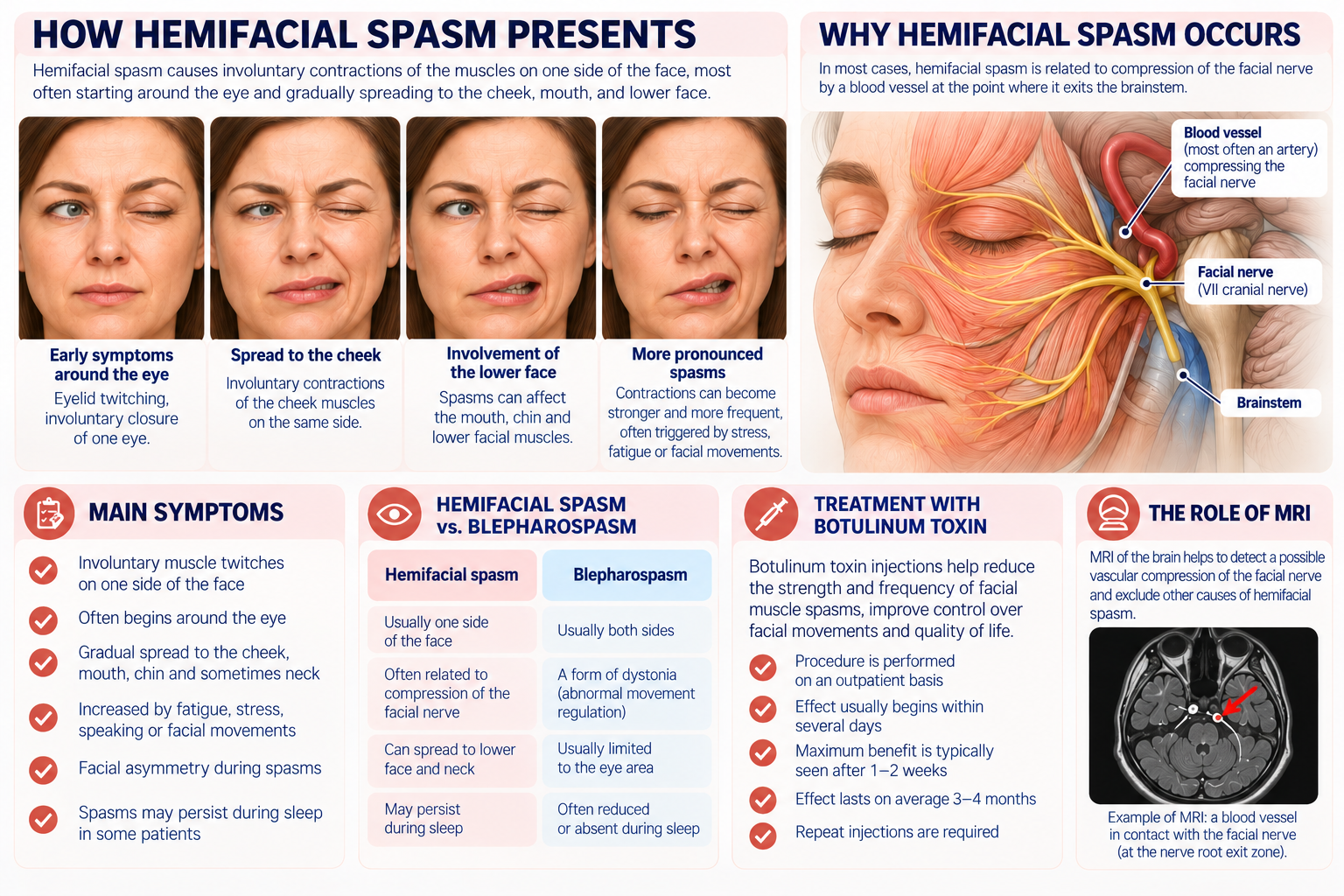
Hemifacial spasm causes involuntary contractions of the muscles on one side of the face. It often begins around the eye and may gradually spread to the cheek, corner of the mouth, chin and sometimes the neck. Botulinum toxin treatment can reduce the frequency and severity of spasms while preserving facial function.
What is hemifacial spasm?
Hemifacial spasm is characterised by recurrent involuntary contractions of muscles supplied by the facial nerve, usually affecting only one side of the face.
In a typical case, symptoms begin with twitching around the eye. Over time, contractions may spread to the cheek, mouth, chin and occasionally the neck.
Typical symptoms
- eyelid twitching on one side;
- involuntary closure of one eye;
- contractions of the cheek or corner of the mouth;
- facial asymmetry during spasms;
- worsening with fatigue, stress, speaking or facial movements;
- in some patients, spasms may persist during sleep.
Why does hemifacial spasm occur?
The most common mechanism of primary hemifacial spasm is contact between a blood vessel and the facial nerve near the point where the nerve exits the brainstem. Repeated vascular pulsation may irritate the nerve and contribute to abnormal electrical activity.
Neurovascular compression
In many patients, an artery is in close contact with or compresses the facial nerve near its root exit zone.
Secondary causes
Less commonly, a similar clinical picture may occur with other structural abnormalities affecting the facial nerve or the posterior fossa.
Hemifacial spasm and blepharospasm are different conditions
- usually affects one side of the face;
- often begins around the eye;
- may spread to the cheek and lower face;
- is related to abnormal activity of the facial nerve;
- may persist during sleep.
- usually affects both sides;
- predominantly involves the muscles around both eyes;
- is a form of focal dystonia;
- often includes frequent blinking and light sensitivity;
- has a different underlying mechanism.
Diagnosis and the role of MRI
Diagnosis is primarily clinical. The neurologist evaluates the distribution and character of facial contractions, the muscles involved and any additional neurological symptoms.
The typical pattern is recurrent unilateral contractions that often begin around the eye and later involve additional muscles on the same side of the face.
Why MRI may be recommended
- to assess the brainstem and facial nerve region;
- to identify possible neurovascular compression;
- to exclude other structural causes;
- to support neurosurgical planning when appropriate.
Botulinum toxin treatment
Botulinum toxin is injected in small doses into muscles involved in the involuntary contractions. It temporarily reduces neuromuscular transmission and decreases the strength of the spasm.
The treatment does not remove an underlying vascular compression of the facial nerve, but it can provide effective symptomatic control for many patients.
Muscle selection and dose distribution are individualised. Excessive weakening of facial muscles can cause unwanted asymmetry, so the aim is to control the spasm while preserving natural facial expression.
Which muscles may be treated?
Orbicularis oculi
Often the first and most visibly affected muscle, particularly during the early stages of hemifacial spasm.
Cheek muscles
As the spasm spreads, involuntary contractions may become evident in the middle part of the face.
Muscles around the mouth
Lower facial involvement may pull the corner of the mouth and produce noticeable facial asymmetry.
Other facial muscles
In more complex patterns, all muscles actually contributing to the abnormal contraction need to be considered.
How treatment is performed
Clinical assessment
The neurologist assesses where the spasm begins and how it spreads across the affected side of the face.
Muscle selection
Muscles contributing most strongly to the involuntary contractions are identified.
Injections
Small doses of botulinum toxin are injected with a fine needle into selected areas.
Refining the plan
The response to the previous cycle is used to adjust future treatment.
When does the effect begin?
Botulinum toxin or microvascular decompression?
Botulinum toxin
Botulinum toxin is a minimally invasive way to control symptoms. Treatment is performed on an outpatient basis and can be repeated.
It is particularly useful for patients who prefer symptomatic treatment or for whom neurosurgical intervention is not appropriate.
Microvascular decompression
In classical hemifacial spasm associated with vascular compression of the facial nerve, microvascular decompression may be considered.
Unlike botulinum toxin treatment, surgery is directed at the underlying neurovascular conflict, but it requires neurosurgical intervention and an individual assessment of potential benefits and risks.
Possible side effects of botulinum toxin
Botulinum toxin treatment for hemifacial spasm is generally well tolerated. Most adverse effects, when they occur, are local and temporary.
- minor bruising or discomfort;
- temporary eyelid drooping;
- temporary smile asymmetry;
- incomplete eyelid closure;
- dryness or irritation of the eye;
- temporary weakness of individual facial muscles.
If previous injections did not help enough
Reassess the distribution
The pattern of muscle involvement can change over time.
Review target muscles
The most visible facial asymmetry does not always identify the muscles driving the spasm.
Review dose distribution
Too little treatment may provide insufficient control, while excessive weakening can affect facial expression.
Reconsider the diagnosis
An atypical clinical pattern may require reassessment of the underlying diagnosis.
Treatment with Dr Lidiia Prakhova
Dr Lidiia Prakhova, MD, PhD, is a neurologist in Israel with experience in movement disorders and botulinum toxin treatment for neurological conditions.
In hemifacial spasm, accurate diagnosis and careful assessment of the distribution of facial contractions are important for selecting the muscles to treat.
If botulinum toxin has been used previously, information about the product, injected muscles, doses, duration of benefit and any adverse effects can help refine the next treatment cycle.
When appropriate, MRI findings and the potential need for a neurosurgical opinion can also be discussed.
Related information
Frequently asked questions
Is hemifacial spasm a form of dystonia?
No. Hemifacial spasm is a separate neurological disorder related to abnormal activity of the facial nerve, commonly associated with vascular compression.
Why does hemifacial spasm affect only one side of the face?
In classical hemifacial spasm, abnormal activity develops in one facial nerve, so the contractions affect muscles supplied by that nerve on one side of the face.
Is MRI necessary?
MRI is often used to evaluate the facial nerve region, possible neurovascular compression and other structural causes. The need for imaging and the appropriate protocol depend on the individual clinical situation.
Does botulinum toxin help hemifacial spasm?
Yes. Botulinum toxin can reduce the frequency and severity of involuntary facial contractions and is an important symptomatic treatment option.
How long does botulinum toxin treatment last?
The effect usually lasts for several months. The treatment interval is adjusted according to the duration of benefit and recurrence of symptoms.
Can hemifacial spasm be treated surgically?
In typical primary hemifacial spasm associated with vascular compression of the facial nerve, microvascular decompression may be considered after neurological and neurosurgical assessment.
How is hemifacial spasm different from blepharospasm?
Hemifacial spasm is usually unilateral and may spread from the eye to the lower face. Blepharospasm is usually bilateral and is a form of focal dystonia.
Consultation for hemifacial spasm in Israel
If involuntary contractions begin around one eye, spread to the cheek or mouth, or previous botulinum toxin treatment provided insufficient benefit, consultation with Dr Lidiia Prakhova can help clarify the diagnosis, assess the need for MRI and plan further treatment.
Book a consultation